Manitoba
An Overview of the Province of Manitoba
Top 15 Most Interesting Facts About Manitoba
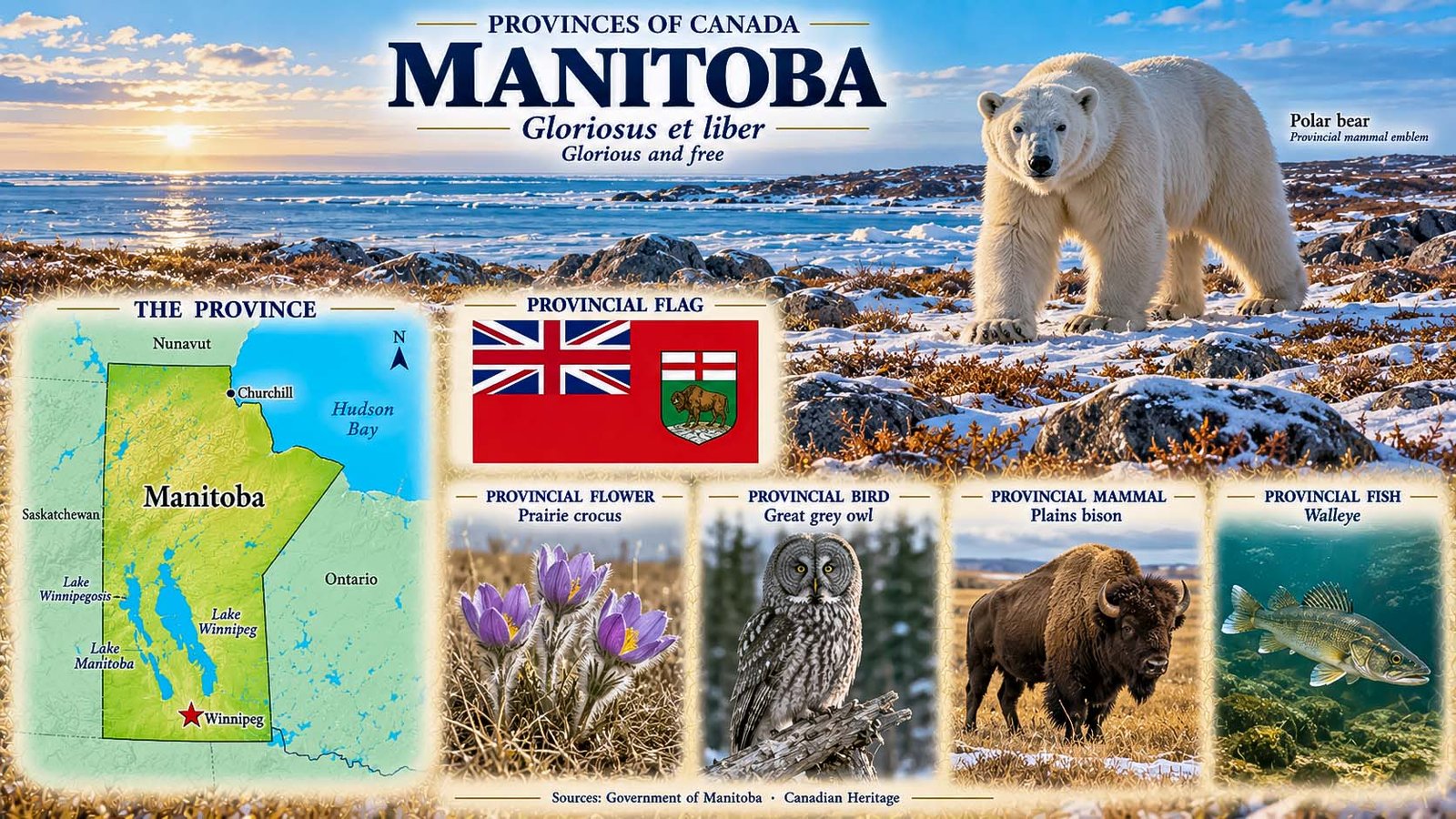
- Province Motto: Gloriosus et Liber, Latin for "Glorious and Free." The phrase echoes the national anthem and appears on the provincial coat of arms.
- Province Bird: The Great Grey Owl, adopted in 1987. This large, silent hunter of the boreal forest has a wingspan of over a meter (about 4 feet) and can hear small animals moving beneath the snow.
- Province Mammal: Manitoba has no widely recognized official provincial mammal, but the plains bison is the animal most closely tied to its identity. A bison stands on a rock on the shield of the provincial coat of arms and on the flag, and bison once roamed the prairies in the millions.
- Province Flag: Adopted in 1966, it is a red field with the Union Jack in the upper left corner and the shield of the provincial coat of arms on the right. The shield shows a bison standing on a rock beneath the red cross of St. George, and the design is a modern version of the Canadian Red Ensign.
- Total Area: About 647,797 square kilometers (250,116 square miles), making Manitoba the sixth largest province in Canada. Roughly 16 percent of that area is water, and the province is often described as the land of 100,000 lakes.
- Capital and Confederation: The capital is Winnipeg. Manitoba joined Canada on July 15, 1870, as the fifth province, after the Red River Resistance led by Louis Riel and the passing of the Manitoba Act. Its original boundaries were so small that it was nicknamed the "postage stamp province," and they were expanded in 1881 and again in 1912.
- A Name from the Water: The name Manitoba is thought to come from Cree or Ojibwe words usually translated as "strait of the spirit" or "the Great Spirit's narrows," referring to the sound of waves on the stony shores of Lake Manitoba. Winnipeg's name comes from the Cree for "muddy water."
- Polar Bear Capital of the World: Each October and November, hundreds of polar bears gather near the town of Churchill on Hudson Bay to wait for the sea ice to freeze. In summer, the same waters are home to one of the largest beluga whale populations in the world, and Wapusk National Park protects one of the largest known polar bear denning areas.
- The Narcisse Snake Dens: Each spring, in late April and May, tens of thousands of red-sided garter snakes emerge from limestone sinkholes in the Interlake region to mate. It is one of the largest gatherings of snakes in the world, and visitors can watch them from safe viewing areas.
- Where the Rivers Meet: The Forks, in downtown Winnipeg, is the meeting point of the Red and Assiniboine rivers and has been a gathering place for Indigenous peoples for about 6,000 years. Today it holds markets, trails, a skating route in winter and the Canadian Museum for Human Rights.
- The Real Winnie: Winnie-the-Pooh was inspired by a black bear cub named Winnipeg, bought in 1914 by Lieutenant Harry Colebourn, a veterinarian from Winnipeg, on his way to the First World War. The bear lived at the London Zoo, where author A. A. Milne's son visited her, and a statue of Colebourn and Winnie stands in Winnipeg's Assiniboine Park.
- Women's Vote: In 1916, Manitoba became the first province in Canada to grant women the right to vote and to hold office in provincial elections, after years of campaigning by suffragists such as Nellie McClung.
- Folklorama and Festivals: Folklorama, held each August in Winnipeg, is one of the largest and longest-running multicultural festivals in the world, with dozens of pavilions that share the food, music and dance of different cultures. In February, the Festival du Voyageur celebrates French-Canadian and Métis heritage with snow sculptures, fiddling and fur trade reenactments.
- A Home for Many Cultures: The province's population of roughly 1.4 million includes large Indigenous, Métis, Ukrainian, German, Mennonite, Filipino, Icelandic, Polish and French-Canadian communities. Gimli, on Lake Winnipeg, is home to the largest Icelandic community outside Iceland.
- Lake Winnipeg: One of the largest freshwater lakes in the world, stretching about 416 kilometers (260 miles) from north to south. It has sandy beaches such as Grand Beach and Gimli, and it is a popular summer destination for sailing, fishing and swimming.
Geography of Manitoba
Manitoba sits at the geographic heart of Canada, bordered by Ontario to the east, Saskatchewan to the west, Nunavut and Hudson Bay to the north and the United States (North Dakota and Minnesota) to the south. It is a land of great variety, with fertile prairie in the south, boreal forest and rocky Canadian Shield in the east and north, and tundra and wetlands along Hudson Bay, which gives Manitoba the only seaport on Hudson Bay in Canada, at Churchill. Most of the south is the flat bed of a vast glacial lake called Lake Agassiz, which left behind rich soil that supports some of the best farmland in the country, and Manitoba's three great lakes (Winnipeg, Manitoba and Winnipegosis) and its many rivers shape much of its landscape and history.
- Highest Point: Baldy Mountain, at about 832 meters (2,730 feet), in the Duck Mountain Provincial Park near the Saskatchewan border.
- Lowest Point: Sea level along the shore of Hudson Bay.
- Mountain Ranges: Manitoba has no true mountain ranges. Its high ground is formed by the Manitoba Escarpment, a line of hills rising above the prairie that includes Riding Mountain, the Duck Mountains and the Porcupine Hills, as well as the Pembina Hills in the south and the rocky uplands of the Canadian Shield in the east and north.
- Major Regions:
- Winnipeg Capital Region: The capital and its surrounding communities, home to more than half of the province's population, at the junction of the Red and Assiniboine rivers.
- Interlake: The land between Lake Manitoba and Lake Winnipeg, with Icelandic and Ukrainian communities, the Narcisse Snake Dens, Hecla Island and the beaches of Gimli.
- Eastman: The southeast corner, with Steinbach's Mennonite heritage, the lakes and forest of Whiteshell Provincial Park and the beaches of Grand Beach on Lake Winnipeg.
- Pembina Valley: The south-central region of rolling hills, orchards and farms around Morden, Winkler and Altona, along the Pembina Escarpment.
- Westman: The southwest, centered on Brandon, with Spruce Woods Provincial Park, the Spirit Sands and the Souris River valley.
- Parkland: A band of aspen forest and rolling hills in the west that includes Riding Mountain National Park, Dauphin and Duck Mountain Provincial Park.
- Northern Manitoba: A vast area of boreal forest, lakes and rivers with mining and Indigenous communities, including Thompson, Flin Flon and The Pas.
- Churchill and the Hudson Bay Coast: The remote subarctic shoreline reached by air or rail, a global destination for polar bears, beluga whales and northern lights.
A Brief History of Manitoba
Indigenous peoples have lived in this land for more than 10,000 years, including the Cree, Ojibwe (Anishinaabe), Dakota, Assiniboine (Nakoda), Dene and Oji-Cree, and in the early 1800s the Métis, descended from Indigenous mothers and fur traders, became a distinct nation with a capital in the Red River Valley. The English explorer Henry Hudson reached Hudson Bay in 1610, and in 1670 the king granted the Hudson's Bay Company a huge trading territory called Rupert's Land that included Manitoba. French explorer Pierre Gaultier de La Vérendrye pushed west in the 1730s and built forts in the region. In 1812, Lord Selkirk settled Scottish and Irish families at the Red River Colony, and tension between the settlers, the fur companies and the Métis led to the Battle of Seven Oaks in 1816. When Canada bought Rupert's Land in 1869 without consulting the people living there, Métis leader Louis Riel formed a provisional government, and the Red River Resistance led to the Manitoba Act and the province's entry into Canada in 1870. Waves of settlers arrived on the new railway, including Ukrainians, Icelanders, Mennonites and Germans, and Winnipeg grew into the "Gateway to the West." The Winnipeg General Strike of 1919, one of the largest labor actions in Canadian history, shaped the country's labor movement, and floods on the Red River, including the great flood of 1950 and 1997, led to the construction of the Red River Floodway. Places to explore this story:
- Visit The Forks National Historic Site in Winnipeg, a meeting place for Indigenous peoples, fur traders and settlers for thousands of years.
- Visit Lower Fort Garry National Historic Site near Selkirk, the best preserved stone fur trading post in North America, with costumed interpreters.
- Visit Riel House National Historic Site in Winnipeg, the family home of Louis Riel, to learn about the Métis leader and the founding of the province.
- Visit the Canadian Museum for Human Rights, the national museum devoted to human rights, which holds galleries on Indigenous perspectives and the history of rights in Canada.
- Visit the Manitoba Museum, with its full-size replica of the 17th-century ship Nonsuch and galleries on the province's natural and human history.
- Visit the Manitoba Legislative Building, a neoclassical landmark topped by the Golden Boy statue, and take a guided tour of its symbolism and history.
- Visit the Mennonite Heritage Village in Steinbach to see how Mennonite settlers lived on the prairie.
- Visit Prince of Wales Fort National Historic Site near Churchill, a massive stone fort built by the Hudson's Bay Company in the 1700s.
Top 10 Things to Do in Manitoba
- Visit Churchill in October and November to see polar bears from a Tundra Buggy, or in July and August to see beluga whales and swim near them, and look for the northern lights on clear nights.
- Visit The Forks in Winnipeg for the market, river walks, the Canadian Museum for Human Rights and, in winter, the skating trail on the frozen river with its warming huts.
- Visit Riding Mountain National Park for hiking, canoeing and wildlife viewing, including a herd of plains bison in an enclosure near the park, and a chance to see black bears and elk.
- Visit the Narcisse Snake Dens in late April and May to watch thousands of red-sided garter snakes at the surface.
- Visit Grand Beach Provincial Park on Lake Winnipeg for a long white sand beach, high dunes and warm summer swimming.
- Visit the Assiniboine Park Zoo and its Journey to Churchill exhibit, which shows polar bears, seals and northern lights in a large arctic habitat.
- Visit Spruce Woods Provincial Park and hike through the Spirit Sands, a patch of shifting desert dunes in the middle of the prairie, to the turquoise Devil's Punch Bowl.
- Visit Whiteshell Provincial Park for lakes, granite cliffs, petroforms (ancient rock arrangements), camping and cottage-country canoe trips on the Canadian Shield.
- Visit during Folklorama in August or the Festival du Voyageur in February to experience the province's rich cultural mix through food, music and dance.
- Visit Gimli, the Icelandic capital of North America, for a stroll on the harbour and beach, the giant Viking statue and a taste of local pickerel (walleye) or Icelandic pastries during the Icelandic Festival of Manitoba in August.
Top 10 Destinations in Manitoba
- Visit Winnipeg, the vibrant capital, with the Exchange District's historic warehouses, The Forks, the Canadian Museum for Human Rights, the Royal Winnipeg Ballet and a strong food and arts scene.
- Visit Churchill, the remote Hudson Bay town known around the world for its polar bears, belugas and northern lights.
- Visit Riding Mountain National Park and the town of Wasagaming, a green island of forest and lakes rising above the prairie.
- Visit Whiteshell Provincial Park, a lake-filled wilderness of the Canadian Shield in the southeast, with beaches, trails and camping.
- Visit Gimli and the Interlake region, with Icelandic culture, Lake Winnipeg beaches, Hecla Island and the Narcisse Snake Dens.
- Visit Grand Beach, widely considered one of the best freshwater beaches in Canada, with sand dunes and a long swimming shore.
- Visit Spruce Woods Provincial Park, with its desert-like Spirit Sands, forest trails and the Assiniboine River valley.
- Visit Hecla-Grindstone Provincial Park, an island park on Lake Winnipeg with a historic Icelandic fishing village, a lighthouse, wildlife viewing and a causeway to the mainland.
- Visit Brandon, the province's second largest city, with a lively downtown, the Riverbank Discovery Centre and the nearby Commonwealth Air Training Plan Museum.
- Visit the Pembina Valley, with Morden and Winkler, the Pembina Hills, the Mennonite Heritage Village in nearby Steinbach and some of the best fall colors on the prairies.
Plan Your Visit
For more information about Manitoba, visit the province's official tourism site: Travel Manitoba